How UK Media Professionals Can Minimise Tax Legally
The UK media industry is a powerhouse of creativity, but for the individuals behind the camera, on the screen, or behind the digital desk, the financial reality is often a complex web of irregular payments and confusing tax codes. Whether you are a seasoned film technician, a rising YouTuber, or a freelance actor, the “creative” part of your job is often overshadowed by the administrative burden of being an accidental business owner.
The truth is that many media professionals in the UK are overpaying their taxes by thousands of pounds every year. This isn’t because they are high earners, but because the UK tax system wasn’t necessarily designed with the fluidity of a media career in mind.
Why Do Most UK Media Professionals Overpay Tax?
If you feel like you are working harder but seeing less in your bank account, you aren’t alone. There is a specific set of “pain points” that lead to tax leakage in this industry.
- The Nature of the Work: Unlike a standard 9-to-5, your year might consist of three months of intense high-pay work followed by two months of “resting” or development. This irregular income often leads to over-taxation in peak months that is never fully reclaimed.
- Lack of Clarity on Deductions: Can you claim that Netflix subscription? What about the “research” trip to a film festival? Without specialized accountants for media, many professionals play it too safe and miss out on valid allowable expenses.
- The “Fear Factor”: HMRC can be intimidating. Many creatives choose to overpay slightly rather than risk an investigation, effectively paying a “worry tax” that they don’t actually owe.
- Generic Advice: Most high-street accountants deal with builders, shopkeepers, and office workers. They don’t understand the nuances of the “wholly and exclusively” rule when it comes to a performer’s wardrobe or a cinematographer’s specialized kit.
How Tax Works for Media Professionals in the UK?
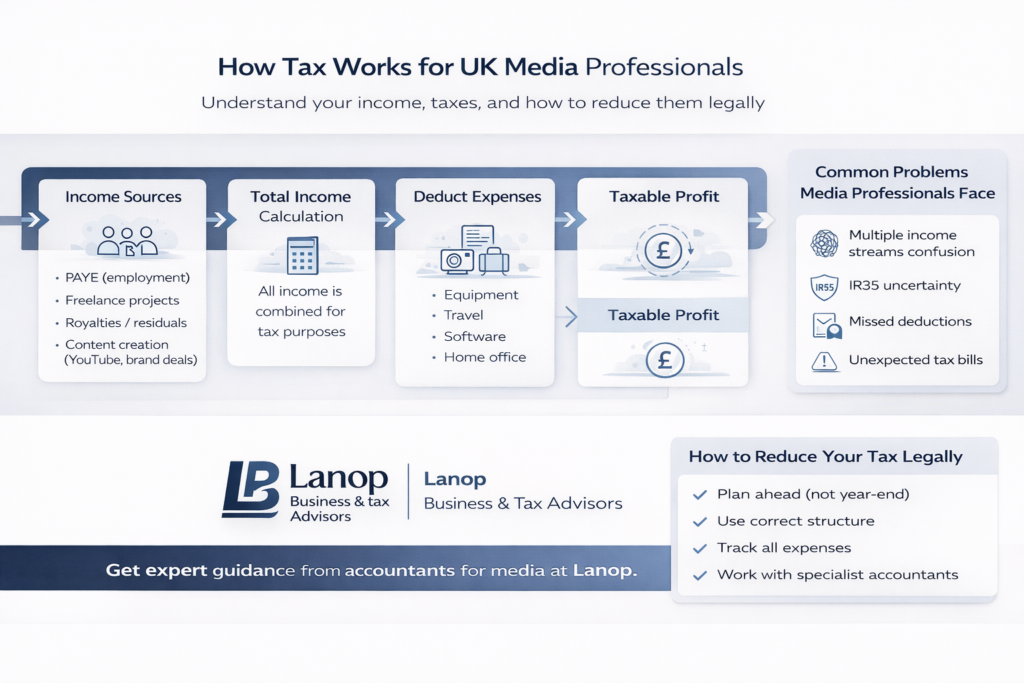
Understanding your tax starts with identifying where your money comes from. In the media, it is rarely just one source.
Types of Income
- PAYE (Employment): Common for long-term crew contracts or recurring TV roles where the production company handles tax at the source.
- Freelance/Self-Employed: Invoice-based work for various production houses or agencies.
- Royalties & Residuals: Payments for past work (e.g., an actor receiving a check for a repeat broadcast).
- Digital Income: AdSense from YouTube, brand deals, and affiliate marketing for content creators.
Taxes You May Pay
- Income Tax: Paid on profits over the Personal Allowance (currently £12,570).
- National Insurance (NI): This varies depending on whether you are an employee (Class 1) or self-employed (Class 2 and 4).
- VAT: If your taxable turnover exceeds £90,000, you must register for VAT.
The Hybrid Income Problem
This is the single biggest cause of confusion. Many media pros have a “day job” on PAYE while running a freelance business on the side. This often leads to your Personal Allowance being used up by your employer, meaning every penny you earn from freelance work is taxed at 20% or 40% from the very first pound. Without proper planning, you might find yourself with a shock tax bill at the end of the year because your employers didn’t know about your other income streams.
The Biggest Tax Mistakes Media Professionals Make
Even the most organized professionals fall into these traps:
- Late Registration: Forgetting to register for Self Assessment by the October 5th deadline after your first year of freelancing.
- Mixing Finances: Using one bank account for groceries and camera gear. This makes it nearly impossible to track expenses accurately during a tax audit.
- Misunderstanding IR35: Assuming that because you have a “Limited Company,” you are safe from being taxed as an employee.
- The “Year-End Scramble”: Waiting until January 30th to look at your receipts. By then, it’s too late to perform any meaningful tax planning.
How to Legally Reduce Your Tax Bill?
The goal of tax planning isn’t to “dodge” tax; it’s to ensure you don’t pay a penny more than the law requires.
Claiming All Allowable Expenses
HMRC allows you to deduct expenses that are “wholly and exclusively” for the purpose of your business. For media pros, this is a broad category.
The Media Professional’s Expense Checklist:
- Travel: Train fares to auditions, mileage to filming locations, and even overseas travel for festivals or shoots (if purely for business).
- Equipment: Cameras, lenses, lighting, laptops, editing software, and “small tools” like cables and hard drives.
- Professional Development: Acting classes, voice coaching, or technical workshops.
- Research & Subscriptions: Trade magazines, Cinema/Spotlight memberships, and streaming services if you are a critic or screenwriter.
- Home Office: A proportion of your rent, heating, and internet if you edit or script-write from home.
Using the Right Business Structure
Choosing between being a Sole Trader or a Limited Company is a mathematical decision, not a lifestyle one.
- Sole Trader: Lower administrative costs, simpler filing, but you are personally liable for business debts.
- Limited Company: More tax-efficient for higher earners (typically those netting over £40,000–£50,000), allows for dividend payments, and offers limited liability.
Decision Framework:
- Profit < £35,000: Usually better to stay as a Sole Trader.
- Profit > £50,000: A Limited Company often becomes more tax-efficient due to the ability to split income between salary and dividends.
Income Timing
If you have a particularly high-earning year, specialized accountants for media might suggest “income shifting.” This could involve making a large pension contribution to bring your taxable income below a certain threshold (like the £100,000 mark where you begin to lose your Personal Allowance) or deferring an invoice until the next tax year.
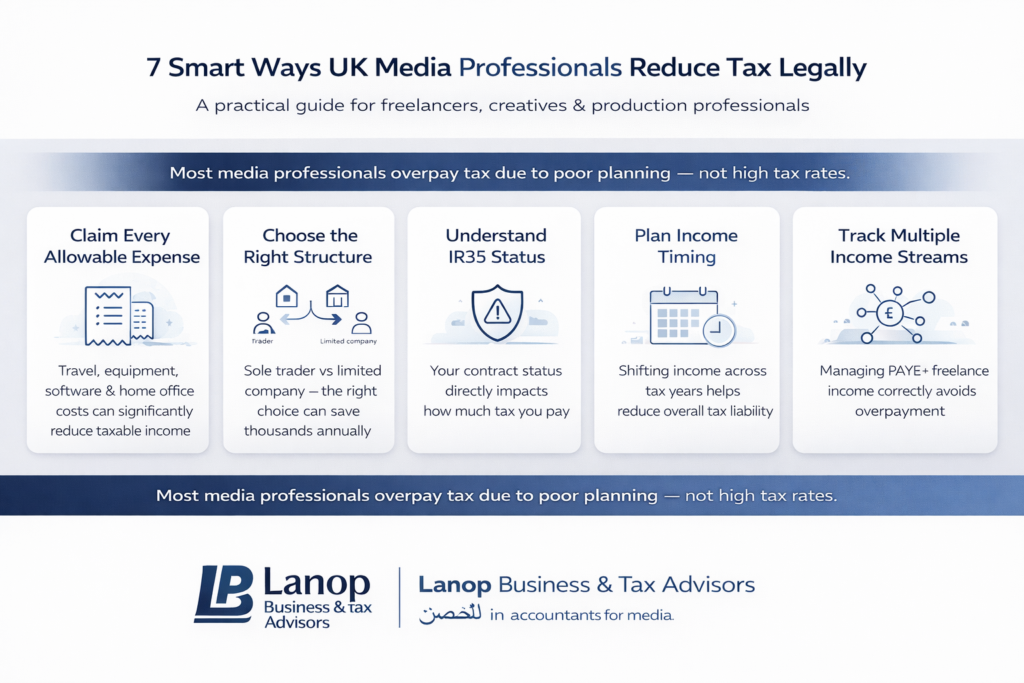
IR35 Explained for Media Professionals
IR35 (Off-Payroll Working) is a piece of legislation designed to stop “disguised employment.” In the media world, HMRC might look at a freelancer who has worked for the same production company for two years and argue they are actually an employee, not a contractor.
The Inside vs. Outside Test:
- Control: Does the client tell you exactly how, when, and where to work? (Suggests “Inside” IR35).
- Substitution: Can you send someone else to do the job in your place? (Suggests “Outside” IR35).
- Mutuality of Obligation: Is the client required to offer you work, and are you required to accept it? (Suggests “Inside” IR35).
Being caught “Inside IR35” means you are taxed as an employee, losing many of the tax benefits of having a Limited Company. Specialized advice is essential here to review your contracts.
Sole Trader vs. Limited Company: A Comparison
| Feature | Sole Trader | Limited Company |
| Setup Cost | Zero | Small fee (Companies House) |
| Tax on Profits | Income Tax (20%–45%) | Corporation Tax (19%–25%) |
| Personal Liability | Unlimited | Limited |
| Privacy | High (Financials are private) | Low (Accounts on public record) |
| Take-Home Pay | Direct | Salary + Dividends |
What Expenses Can Media Professionals Actually Claim?
Beyond the basics, there are hidden deductions that many miss:
- Agent & Management Fees: Fully deductible.
- Professional Indemnity Insurance: Essential for freelancers and fully claimable.
- Hair & Makeup: Only claimable if it is specifically for a role or a shoot (stage makeup, not “everyday” grooming).
- Security & Storage: If you pay to store expensive equipment or have specialized insurance for it.
Managing Multiple Income Streams
If you are receiving royalties from a project in 2022, a PAYE salary for a show in 2026, and brand deal money from Instagram, your tax code is likely a mess.
The key is consolidation. You need a central system (or a specialized accountant) to track every stream. This prevents “double-taxation” where two different employers think you have already used your tax-free allowance, leading to underpayments that HMRC will eventually claw back with interest.
How Much Tax Should You Set Aside?
The “Creative’s Curse” is the tax shock in January. Because self-employed tax is paid in arrears, you might have a great year, spend the money, and then realize you owe 30% of it to the government.
The Golden Rule: Set aside 25% to 30% of every single invoice into a separate “Tax Savings” account. Don’t touch it. It isn’t your money, it belongs to HMRC; you’re just holding onto it for a while.
How to Avoid HMRC Penalties?
HMRC is increasingly using automated systems to find discrepancies. To stay off their radar:
- Keep Digital Records: Use software like Xero or QuickBooks.
- Don’t Guess: If you don’t have a receipt, don’t claim it.
- File Early: Filing in July instead of January gives you months to plan how to pay the bill.
Do You Need Accountants for Media Professionals?
You can do your own taxes, but is it the best use of your time?
When DIY Stops Working?
- When your income exceeds £50,000.
- When you have more than three different income streams.
- When you are confused by IR35 status.
The ROI of Professional Advice
A specialized accountant doesn’t just “file” your taxes; they perform tax engineering. If an accountant costs you £1,200 a year but finds £4,000 in deductions you missed and saves you £2,000 in penalties through correct IR35 positioning, they haven’t cost you anything; they’ve made you £4,800.
Real-Life Examples
Case 1: The Freelance Editor
- Income: £45,000 (Freelance).
- Mistake: Not claiming “Home Office” use or software subscriptions.
- Saving: By claiming 15% of household bills and all Adobe Creative Cloud costs, they reduced their taxable profit by £3,500, saving £700 in tax.
Case 2: The Actor
- Income: £25,000 (PAYE) + £15,000 (Commercials/Freelance).
- Mistake: Thinking the PAYE tax covered everything.
- Saving: Accountants for media restructured their freelance expenses to include agent fees and Spotlight dues, preventing a £3,000 tax bill surprise.
Action Plan: Start Minimising Your Tax Today
- Review your structure: Are you earning enough that a Limited Company makes sense?
- Audit your expenses: Go back through three months of bank statements. What did you miss?
- Check your IR35 status: If you are on a long-term contract, get it reviewed.
- Open a tax account: Start moving 25% of your income today.
- Consult an expert: Reach out to a firm that understands the industry.
How Lanop Business and Tax Advisors Help Media Professionals?
At Lanop Business and Tax Advisors, we don’t just look at spreadsheets; we look at the industry. We understand that a film crew’s “travel” isn’t just a commute.it’s a logistical challenge. We know that a YouTuber’s “gear” is their livelihood.
We provide:
- Bespoke Tax Strategies: Tailored to the irregular cycles of media work.
- IR35 Contract Reviews: Ensuring you are protected from misclassification.
- Proactive Planning: We speak to you throughout the year, not just in January.
Stop overpaying the “creative tax.” Let Lanop handle the numbers so you can focus on the narrative.
Frequently Asked Questions
What are the biggest tax deductions UK media professionals often miss?
Equipment purchases (cameras, microphones, editing software, computers), home studio costs (portion of rent, utilities, internet), professional subscriptions, industry memberships, marketing expenses, and travel to shoots or client meetings are commonly under-claimed. Media professionals can also claim continuing professional development courses, insurance, website hosting, cloud storage, and accountancy fees. Keeping detailed records and receipts for all business expenses maximizes legitimate deductions and significantly reduces taxable income.
Should I operate as a sole trader or set up a limited company?
If your media income is under £50,000 annually, sole trader status is simpler with less admin and lower accounting costs. Once profits consistently exceed £50,000–£60,000, incorporating as a limited company becomes more tax-efficient you’ll pay corporation tax at 19%–25% instead of income tax at 40%–45%, plus gain flexibility with salary/dividend combinations. A specialist media accountant can model both scenarios based on your specific income and expenses.
How does IR35 affect freelance media professionals working through limited companies?
IR35 determines whether you’re genuinely self-employed or effectively an employee for tax purposes. If caught inside IR35, you lose tax advantages and must pay income tax and National Insurance as if employed. To stay outside IR35 legitimately, ensure you control how/when you work, use your own equipment, work for multiple clients, and can send substitutes. Medium and large clients now assess IR35 status, so proper contracts and working practices are essential.
Can I claim tax relief on creative content I produce for my portfolio?
Yes, if the content is genuinely created to showcase skills, attract clients, or develop your media business. Costs for self-funded projects, demo reels, spec work, and portfolio pieces are allowable business expenses including production costs, editing time, and hosting fees. However, purely personal creative projects with no business purpose aren’t deductible. Keep evidence showing business intent, client pitches, portfolio updates, marketing use.
What pension strategies work best for maximizing tax relief as a media professional?
Contributing to a Self-Invested Personal Pension (SIPP) provides immediate tax relief at your highest marginal rate 20%, 40%, or 45% depending on income. If operating through a limited company, employer pension contributions are corporation tax deductible and don’t trigger personal tax or National Insurance. Regular pension contributions reduce taxable income, smooth out volatile earnings, and build retirement security while legally minimizing tax liability throughout your career.
Conclusion: Keep More of What You Earn
The media industry is unpredictable enough without losing a larger chunk of your income to unnecessary tax. As a UK media professional, you work hard for every project, pitch, and paycheck ensuring you’re maximizing legitimate tax reliefs and structuring your business efficiently isn’t optional, it’s essential.
From claiming overlooked expenses and optimizing your business structure to navigating IR35 complexity and planning pension contributions strategically, the right tax guidance transforms your financial position. The difference between paying what you must and paying what you think you should can be thousands of pounds annually.
Lanop Business and Tax Advisors specializes in working with media professionals, creatives, and freelancers across the UK. We understand the unique challenges of irregular income, project-based work, and evolving tax regulations that affect your industry.
Ready to minimize your tax legally and keep more of what you earn? Contact Lanop Business and Tax Advisors today for a free consultation. We’ll review your current setup, identify missed deductions, and create a tax-efficient strategy tailored to your media career.
Don’t overpay tax,get expert support from Lanop Business and Tax Advisors now.
About the Author