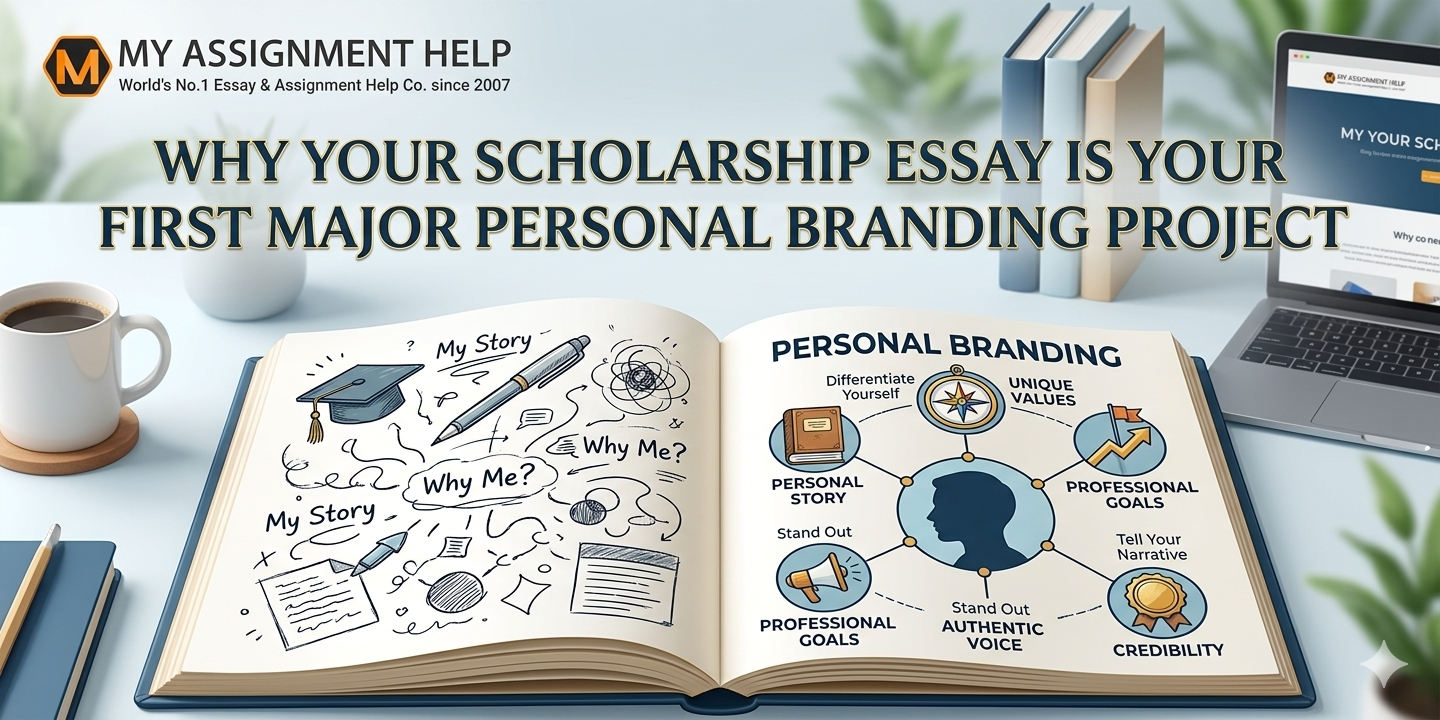
In the hyper-competitive landscape of American higher education, where tuition inflation outpaces wage growth and the “student debt crisis” is a recurring headline, a scholarship isn’t just a financial windfall. It is a validation of potential. However, most applicants approach the scholarship essay as a hurdle—a formal requirement to be checked off.
In reality, the scholarship essay is your first high-stakes personal branding project. It is the moment you transition from being a set of data points (GPA, SAT scores, ZIP code) to a compelling, living narrative. To win, you must stop “writing an essay” and start “building a brand.”
The Shift from Academic Writing to Personal Branding
Personal branding is the intentional effort to create and influence public perception of an individual by positioning them as an authority in their industry, elevating their credibility, and differentiating them from the competition. While this sounds like corporate jargon, it is the exact mechanism that scholarship committees use to filter thousands of applications.
When a committee at a foundation or university reviews your folder, they are looking for an “ROI”—Return on Investment. They aren’t just giving money; they are investing in a future leader, a researcher, or a community changemaker. Your essay is the “pitch deck” for the brand of You.
Why Narrative Authority Matters (E-E-A-T)
Google uses E-E-A-T (Experience, Expertise, Authoritativeness, and Trustworthiness) to rank content, and scholarship committees use a human version of the same algorithm.
- Experience: Have you lived the challenges you are writing about?
- Expertise: Do you demonstrate a deep understanding of your chosen field?
- Authoritativeness: Are you a leader or a contributor in your community?
- Trustworthiness: Is your story consistent, cited (where applicable), and authentic?
The Strategic Anatomy of a Branding-First Essay
To treat your essay as a branding project, you must move beyond the “What” and focus on the “Why” and the “So What.”
1. Defining Your Unique Selling Proposition (USP)
Every brand has a USP. In a sea of “hardworking students” and “future doctors,” your USP must be specific. Instead of saying “I am a leader,” your brand narrative should be “I am a bridge-builder who uses data science to solve food insecurity in urban deserts.”
If you find yourself struggling to articulate this unique angle, seeking professional myassignmenthelp can provide the clarity needed. Utilizing a professional scholarship essay writing service helps in distilling complex personal histories into a cohesive brand identity that resonates with specific donor values.
2. Market Research: Understanding the Donor
A branding project fails if it doesn’t understand its audience. A scholarship from the Coca-Cola Scholars Foundation requires a different brand voice than a niche grant from the National Society of Black Engineers (NSBE).
- The Corporate Donor: Values leadership, scale, and brand alignment.
- The Academic Donor: Values research potential, intellectual curiosity, and pedigree.
- The Community Donor: Values “boots on the ground” impact and local roots.
Data-Driven Insights: The Cost of Missing the Mark
According to the National Center for Education Statistics (NCES), for the 2022-2023 academic year, the average cost of attendance for a full-time student at a four-year institution was approximately $30,000 to $58,000 depending on the sector. With nearly $100 million in scholarship funds going unclaimed annually—often due to a lack of qualified applicants or poor-quality submissions—the stakes of your personal branding are measurable in tens of thousands of dollars.
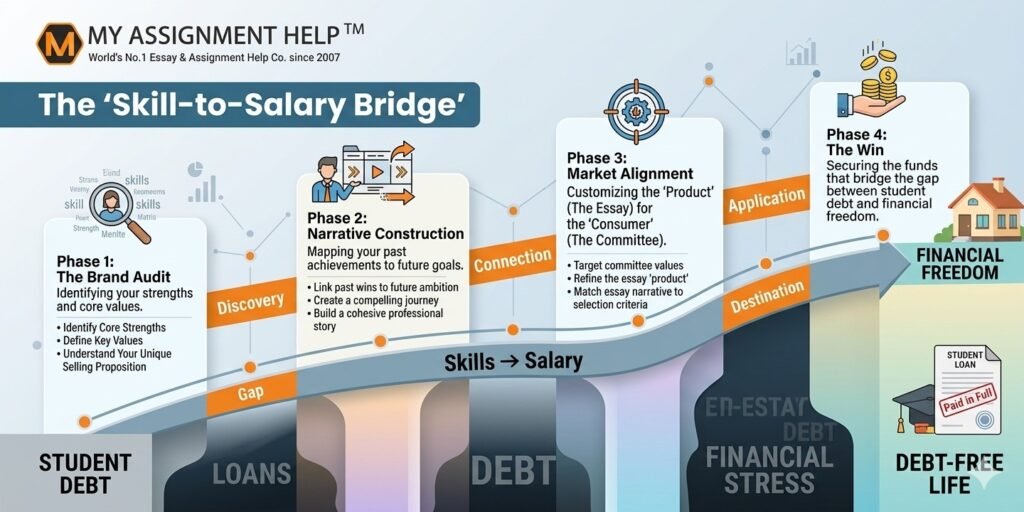
Strategic Execution: How to Build the Brand
The Hook: The “Brand Promise”
Don’t start with “My name is…” Start with a transformation. A brand promise tells the reader what to expect. If your brand is “Resilience,” start in the middle of a storm. If your brand is “Innovation,” start with the moment a system broke and you fixed it.
The Body: Evidence-Based Storytelling
In SEO and content strategy, we say “Show, Don’t Tell.” In branding, we provide social proof. Don’t just say you are a volunteer; describe the 12% increase in literacy rates you helped achieve at the local library. Use data to ground your narrative.
For students balancing rigorous STEM or Law workloads, finding the time to execute this level of strategic writing is difficult. It is common for high achievers to reach out and say, “do assignment for me” to clear the administrative brush, allowing them to focus entirely on the high-level branding required for prestigious scholarships like the Rhodes or Fulbright.
The Conclusion: The Call to Action (CTA)
A branding project always ends with a CTA. In a scholarship essay, the CTA is your vision of the future. How will the donor’s investment facilitate a change in the world?
Avoiding the “Generic Brand” Trap
The biggest threat to your personal brand is “Generica.” This happens when students use clichés like:
- “Since a young age…”
- “I want to help people…”
- “This scholarship will help me reach my goals…”
The Branding Fix: Replace these with specifics. “My fascination with blockchain began in a rural village in India…” or “I intend to restructure the administrative law framework for telecommunications…”
Key Takeaways for Your Branding Project
- View the Committee as Investors: They are buying into your future; show them the roadmap.
- Consistency is Key: Your essay, LinkedIn profile, and resume should all tell the same “Brand Story.”
- Data Matters: Use specific metrics (percentages, hours, dollar amounts) to prove your impact.
- Professional Alignment: Ensure your “Brand” aligns with the mission statement of the scholarship provider.
- Quality Control: A single typo can break the “Trustworthiness” pillar of your E-E-A-T.
FAQ Section
Q1: Is personal branding in an essay “fake”?
No. Personal branding is about curation, not fabrication. It is about highlighting the most relevant truths of your life to meet a specific goal.
Q2: How long should a scholarship essay be for maximum impact?
Most vary between 500 to 1,000 words. The key is “Density”—how much value and information can you pack into every sentence?
Q3: Can I use the same “Brand Story” for every scholarship?
You should have a “Master Brand,” but you must “localize” it for each donor. A tech scholarship wants to hear about your coding; a leadership scholarship wants to hear about your team management.
Q4: Should I mention my financial need in a branding project?
Yes, but frame it as a “Resource Constraint” that, once removed, will allow your “Brand” to scale its impact.
About the Author: Sarah Jenkins
Sarah Jenkins is a Senior Academic Consultant and Content Strategist at MyAssignmentHelp. With over a decade of experience in higher education admissions and strategic communications, Sarah has helped thousands of students navigate the complexities of the Australian Qualifications Framework (AQF) and US Ivy League admissions. She specializes in narrative development and E-E-A-T compliant academic writing, ensuring that every student’s personal brand stands out in a crowded global market.
References
- National Center for Education Statistics (2023). “Price of Attendance for First-Time, Full-Time University Students.”
- U.S. Department of Education. “The Impact of Pell Grants on Graduation Rates.”
- Council for Advancement and Support of Education (CASE). “Trends in Student Philanthropy and Donor Intent.”
About the Author